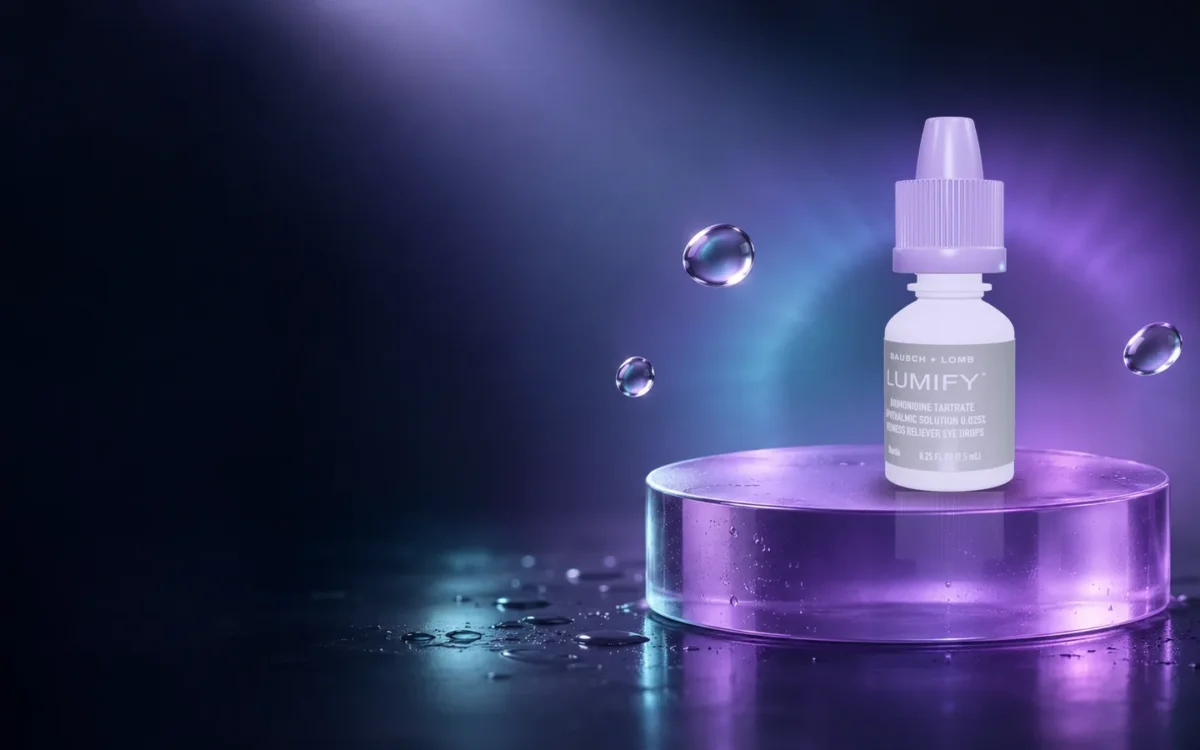
Genuine Lumify comes in a sealed carton with the US “Drug Facts” label in English, and a batch number and expiry date that match the bottle or vials inside. Fake and tampered medicines do turn up, especially online, so a two-minute check before you open anything is worth doing, wherever you bought it. Here’s the checklist, plus what to do if something looks off.
Why check at all?
Eye drops go straight into your eye, so you want to know they’re what the pack says they are. The UK medicines regulator, the MHRA, asks people to report suspected fake products, “especially those bought online or via social media” (MHRA). That’s not a reason to panic. It’s a reason to look before you use.
Before you buy: is the seller real?
- Find the seller’s details. A UK address, a company name and a way to contact them should be easy to find on the site. If you can’t work out who you’re buying from, that’s a warning sign.
- Be wary of social media and anonymous marketplace listings. No name, no address and payment by bank transfer only? Walk away.
- If the price looks too good to be true, it probably is. A pack going for a fraction of what everyone else charges deserves a second look.
- Check the size on offer. Lumify bottles come in set sizes; the ones we sell are 2.5 ml and 7.5 ml, plus the Preservative Free vials. Our Lumify sizes guide has the details.
Use the same checks on us. That’s the point of a checklist.
Is my Lumify real? The unboxing checklist
Do this before you open the bottle or a vial.
- The carton is sealed. It shouldn’t look opened, re-glued, crushed or water-damaged.
- The Lumify seal on the bottle is intact. If there’s any seal on the cap or neck and it’s broken, missing or looks fiddled with, don’t use the bottle.
- Preservative Free vials are still in sealed pouches. The pack holds 20 single-use vials, as 4 pouches of 5, each vial 0.4 ml. The label says to use them “only if pouch is sealed and single-use vial is intact.”
- The Drug Facts label is there, in English. The US Food and Drug Administration requires a standard label on all over-the-counter medicines, with headings including active ingredient, purpose, uses, warnings, directions, other information and inactive ingredients (FDA). Genuine US Lumify has it on the carton. Missing sections, or a label in another language, are red flags.
- The batch (lot) number and expiry date are printed and match. Look for them on the carton and on the bottle. They should be the same on both, and clearly printed, not handwritten or on a sticker covering something else.
- The print quality is consistent. Sharp text, even colours, no spelling mistakes, no blurry logos, no mismatched fonts. Compare it with the pack shots on the maker’s own website if you’re unsure.
- The directions match. The US Lumify bottle label says 1 drop in the affected eye(s) every 6 to 8 hours, no more than 4 times a day, contact lenses out first, and wait at least 10 minutes before putting them back in. Different directions are a reason to stop and ask.
Check the Lumify expiry date and the liquid
- Check the expiry date before you open it. Don’t use any eye drops past the date on the pack.
- Look at the liquid. The label says: “Do not use if solution changes color or becomes cloudy.”
- Store it properly once it’s yours. The label says to store Lumify at 15 to 25°C. The Preservative Free pack adds “protect from light”, and says to keep unused vials in the carton.
- Once you’ve opened a vial, use it and bin it. The Preservative Free label says to throw the vial away straight after use and not re-use it.
For the full how-to, see how to use Lumify.
Think it’s a fake Lumify? What to do
- Don’t use it. If you’ve already used it and your eye feels wrong, see the box below.
- Keep everything. The carton, the bottle or vials, the packaging it came in and your order confirmation. Take photos of the lot number and expiry date.
- Contact the seller. Tell them what you found and ask for an explanation.
- Report it to the MHRA. The Yellow Card scheme takes reports of “fake or counterfeit medicines or medical devices”, as well as side effects (MHRA guidance). You can report online at yellowcard.mhra.gov.uk.
If you had a side effect from any eye drop, real or suspected fake, you can report that through Yellow Card too.
Is Lumify in the UK real? How we do it
Here’s what we do, and nothing more than that:
- We sell sealed US retail packs of Lumify, from Bausch + Lomb.
- We show the expiry date on our product pages, so you can see it before you buy.
- We send from UK stock, with free Royal Mail tracked delivery on every UK order and no customs charges at the door. UK addresses only.
- We sell to adults (18+) only.
- Unopened, sealed items can come back under our returns policy. Opened eye drops can’t, for hygiene reasons, unless they’re faulty. If something about your pack doesn’t look right, contact us before you open it.
Want the background on Lumify in the UK? Read our Lumify eye drops UK guide. Buying Clear Eyes too? The same checks work for it: see our Clear Eyes UK guide. Ready to buy? Shop Lumify.
When to see someone
When to see someone. If you’ve used drops you think might be fake and your eye is painful, your sight has changed, it hurts to look at light, or the redness or irritation carries on or gets worse, stop using them and get help. Call 999 or go to A&E for a red eye with any change in your sight (such as wavy lines, flashing or loss of vision), pain when you look at light, a severe headache with feeling sick, or one pupil bigger than the other, or after an eye injury or a chemical in the eye. Get an urgent GP or optician appointment, or contact NHS 111, if your eye is very painful and red, or if you wear contact lenses and have a red eye: take the lenses out, because it could be an infection. Take the pack with you. Report side effects and suspected fakes through the Yellow Card scheme. A pharmacist or optician can help with anything you’re unsure about.
Questions
How can you tell if Lumify is fake?
Check that the carton is sealed, any seal on the bottle is intact, the English Drug Facts label is there, the batch number and expiry date are printed and match on carton and bottle, and the print is sharp and consistent. Don’t use it if anything looks off, or if the liquid is cloudy or has changed colour.
Is my Lumify real if the box is in American English?
US-pack Lumify carries the US Drug Facts label, so American spellings like “color” are normal. What matters is that the label is complete, clearly printed and matches the bottle inside.
Where is the expiry date on Lumify?
Look on the carton and on the bottle or vials. The date should be printed, not handwritten, and should match on both. We also show the expiry date on our product pages.
Does Lumify have a seal?
Check for a sealed carton and, on the bottle, any seal on the cap or neck. If anything is broken, missing or looks tampered with, don’t use it. Preservative Free vials should be in sealed pouches: the label says to use them only if the pouch is sealed and the vial is intact.
Can I use Lumify after the expiry date?
No. Don’t use eye drops past the expiry date on the pack. Check it before you open a new bottle.
My Lumify looks cloudy. Can I still use it?
No. The label says: “Do not use if solution changes color or becomes cloudy.” Keep the bottle and contact the seller.
How do I report fake eye drops in the UK?
Report a suspected fake medicine to the MHRA through the Yellow Card scheme, online at yellowcard.mhra.gov.uk. Keep the pack and your order details, and tell the seller too.
Is Lumify sold in the UK real?
It depends who you buy from. Ours are sealed US retail packs, sent from UK stock, with the expiry date on the product page. Whoever you buy from, run through the checklist above before you open the pack.
Sources
- DailyMed (US National Library of Medicine), LUMIFY redness reliever eye drops label
- DailyMed (US National Library of Medicine), LUMIFY Preservative Free eye drops label
- US Food and Drug Administration, The Over-the-Counter Drug Facts Label (content current as of 2 September 2026)
- MHRA, The Yellow Card scheme: guidance for healthcare professionals, patients and the public (updated 24 July 2025)
- MHRA, MHRA calls on public to report side effects and suspected fakes during #MedSafetyWeek (3 November 2025)
- MHRA, Yellow Card scheme
- NHS, Red eye (reviewed 27 October 2025)
All sources accessed 5 November 2026.
This guide is general information, not medical advice. Always read the label and leaflet. For anything about your own eyes, ask a pharmacist, an optician or your GP. If you have eye pain, a sudden change in your sight or an eye injury, call NHS 111, or 999 in an emergency.